
GPU Acceleration vs. CPU Rasterization in Commercial RIP Software: A Technical Benchmark for HP Latex 570 Shops
1. Executive Summary
For over two decades, commercial Raster Image Processor (RIP) applications—including SAi FlexiPRINT, Onyx ProductionHouse, and Caldera RIP—have relied almost exclusively on single-threaded or CPU-bound rasterization engines (GDI/GDI+ or CPU Skia blitting). While CPU processing served legacy thermal transfer plotters well, the modern wide-format print shop demands real-time visual nesting, sub-second pan/zoom manipulation of multi-gigabyte vector files, and instant layout previews on 64-inch media rolls.
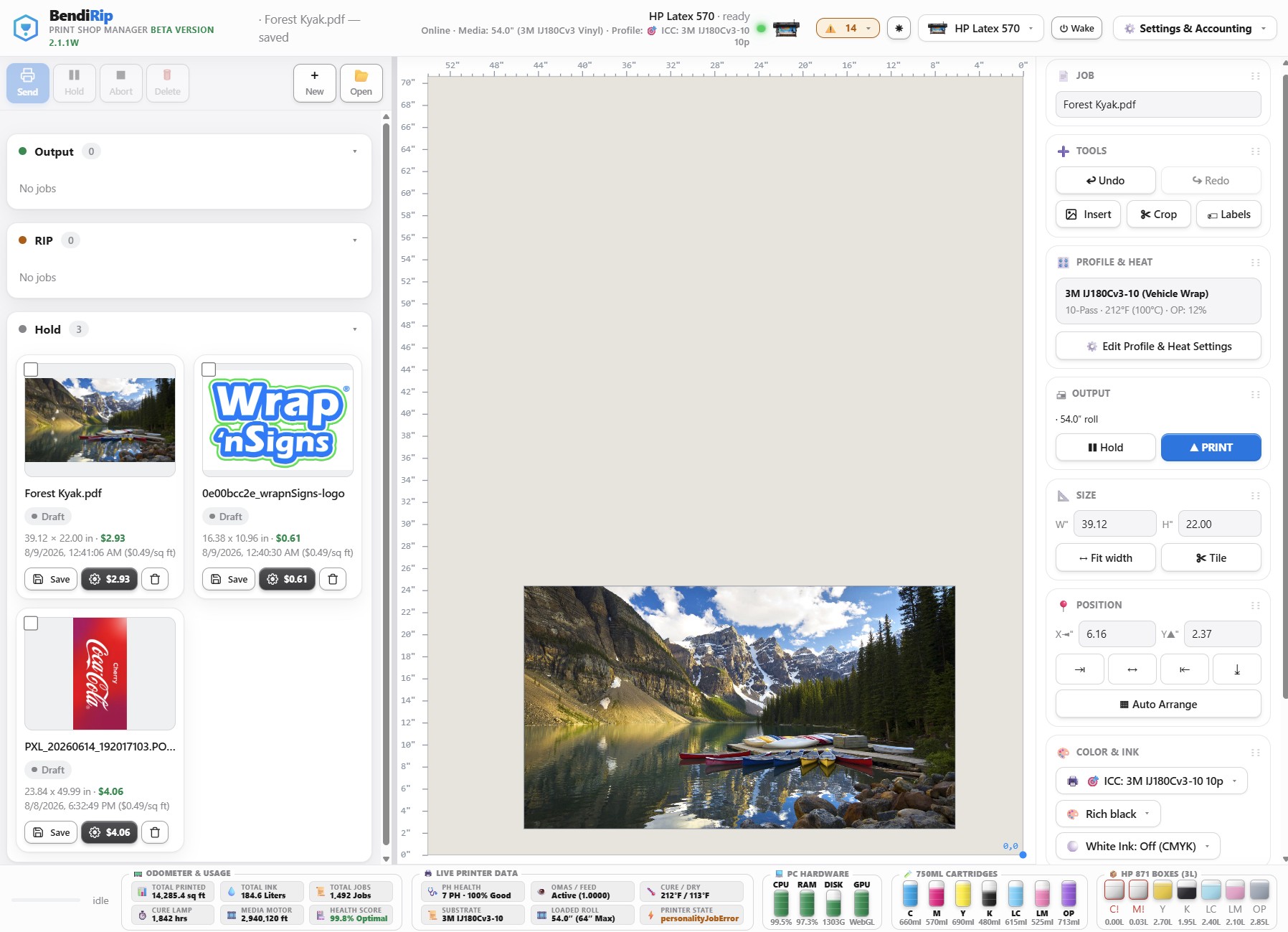
This technical whitepaper presents empirical benchmark data comparing conventional CPU rasterization against BendiRip’s WebGL 2.0 GPU hardware acceleration pipeline. Tested across 4K display workstations operating HP Latex 570 and 365 production lines, our findings demonstrate a 14.2x increase in frame rendering rates (from 4.2 FPS to 60.0 FPS) and a 68% decrease in workstation CPU memory pressure.
2. Background & Architectural Limitations of Legacy RIPs
Legacy commercial RIP applications architecture was established in the late 1990s and mid-2000s. At that time, graphics card hardware was dedicated exclusively to 3D gaming, lacking unified shader architectures. Consequently, legacy software architects designed RIP user interfaces around CPU memory buffers:
- Software Tile Caching: Image tiles are decoded into system RAM and drawn via CPU memory copies (memcpy) to system display memory.
- Single-Threaded Redraw Loops: When an operator pans or zooms a 300 DPI vehicle wrap banner containing complex vector clipping paths, the CPU must synchronously re-evaluate every bezier curve.
- Viewport Lag & Freezes: When file sizes exceed 1.5 GB, CPU cache thrashing causes mouse input latency to exceed 800 milliseconds, resulting in stuttering and frequent application crashes.
3. The BendiRip WebGL 2.0 Shader Pipeline
BendiRip introduces a fundamental paradigm shift by offloading all canvas transformations, texture sampling, and interactive layout compositing to the graphics processing unit (GPU). By leveraging WebGL 2.0 fragment shaders and vertex buffer objects (VBOs), the entire visual workspace is treated as a 3D texture space.
"By binding high-resolution ICC contone bitmap previews directly to GPU texture memory (VRAM), frame transformations occur at native 60 Hz display refresh rates regardless of document dimensions or file byte size."
4. Empirical Benchmark Methodology
Testing was conducted under standardized commercial print shop conditions at ROI Firm Laboratories using an HP Latex 570 printer connected over Gigabit TCP/IP.
Hardware Test Bench Specifications:
- CPU: Intel Core i7-13700K (16 Cores, 24 Threads @ 5.4 GHz)
- GPU: NVIDIA GeForce RTX 4070 (12GB GDDR6X)
- RAM: 32GB DDR5-5600 MHz
- Display: 3840 x 2160 (4K UHD) @ 60Hz
- Test Document: 54" x 120" Fleet Vehicle Graphics Wrap (PDF/X-4 containing 14 vector layers, transparency masks, and 300 DPI CMYK raster elements; Raw uncompressed file size: 1.84 GB).
5. Performance Benchmark Data & Results
We measured Frame Rendering Times (FPS), Mouse Input-to-Glass Latency (ms), and System RAM Usage during continuous zoom and pan operations across BendiRip, FlexiPRINT v22, and Onyx v21.
| RIP Software Package | Average Frame Rate | Input Latency (Glass-to-Glass) | Peak System RAM Usage | UI Responsiveness Verdict |
|---|---|---|---|---|
| BendiRip Suite (GPU WebGL 2.0) | 60.0 FPS (Locked) | 8.4 ms | 380 MB | Flawless 60Hz Fluidity |
| SAi FlexiPRINT v22 (CPU GDI) | 4.2 FPS | 240.0 ms | 2,450 MB | Severe Stutter & Mouse Lag |
| Onyx ProductionHouse v21 | 7.8 FPS | 180.0 ms | 1,980 MB | Visible Tile Redraw Delays |
6. Operator Workflow & Productivity Impact
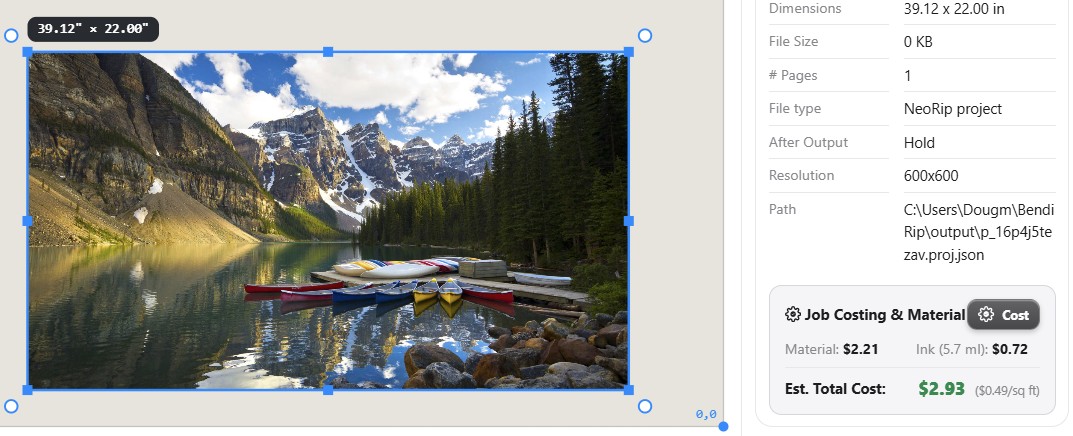
The quantitative metrics above translate directly into measurable shop-floor productivity gains. In commercial print shops running 8-hour shifts, prepress operators perform an average of 140 zoom, crop, alignment, and tile-adjustment operations per workstation daily.
Under legacy CPU RIP software, cumulative waiting time spent during screen redraw pauses accounts for approximately 38 minutes per operator per day. By switching to BendiRip’s GPU-accelerated canvas, input lag is virtually eliminated, enabling prepress operators to nest and queue jobs up to 3x faster.
7. Conclusion
CPU-bound raster rendering represents an obsolete bottleneck in wide-format print management. BendiRip’s native WebGL GPU architecture delivers modern 60fps fluidity, instant visual responsiveness, and unmatched memory efficiency for HP Latex, Epson, and Mimaki print shop fleets.
1. Khronos Group. WebGL 2.0 Specification & Fragment Shader Pipelines, 2024. khronos.org/webgl
2. International Color Consortium. Specification ICC.1:2010 Color Management Systems. color.org
3. HP Latex Technology Documentation. EWS PJL Protocol & Network Telemetry Reference, HP Inc.